The resonance test on this site works by feel; with a chest strap and an HRV app it becomes a measurement. Any of the five straps below sends beat-to-beat (RR) intervals over Bluetooth, which is the one thing the test needs. Prices are from Amazon and change; links open your local Amazon store where one exists, and we earn a commission if you buy, at no extra cost to you. We own no relationship with any of the makers and did not receive review units. How to run the test with a strap.
What matters for HRV breathing, and what does not
Every strap here measures the heart's electrical signal from the chest, which is what makes beat-to-beat timing reliable enough for HRV; wrist and finger devices use light and are built for overnight averages, not a two-minute paced test. Beyond that, the differences are about convenience: how many devices can connect at once, whether the strap stores data when the phone is away, battery type, and running metrics you will not use while sitting still. For this test, a Bluetooth connection to the app, a comfortable strap and a battery that lasts are the whole list.
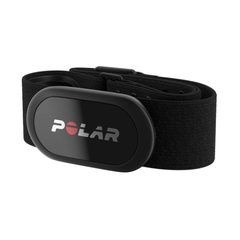
Polar H10
The strap most HRV apps name first, and the one with a published check on its beat-to-beat quality: in a 2019 study at the Swiss Federal Institute of Sport, the H10 correctly detected 99.6% of RR intervals across rest and exercise against a raw ECG, better than the clinical Holter it was compared with [Gilgen-Ammann, Schweizer & Wyss 2019]. Bluetooth LE and ANT+, two simultaneous Bluetooth connections, one session of on-board memory (up to 30 hours), a CR2025 coin cell rated at about 400 hours, WR30 water resistance, and Polar's Pro strap in XS-S, M-XXL and XXXL [Polar specifications]. The connection you need for the test, plus more you will not.
Pick it if you want the reference strap and may also use it for training, where two connections and memory matter. Polar H10 on Amazon
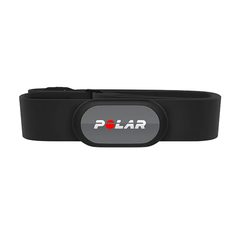
Polar H9
Polar's less expensive strap. Same electrical measurement, Bluetooth LE, ANT+ and 5 kHz, the same 400-hour coin cell and WR30 rating, but a single Bluetooth connection and no memory [Polar specifications]. For a paced breathing test with a phone on the desk, neither missing feature matters; the app records, the strap only has to send.
Pick it if the test and occasional workouts are the whole use, and the price difference is better spent on the book. Polar H9 on Amazon
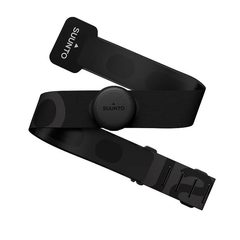
Suunto Smart Heart Rate Belt 2
Suunto's newest strap, released in 2025: up to three simultaneous Bluetooth connections, about 20 hours of on-board RR memory that syncs back to a Suunto watch, a CR2032 coin cell rated at about 460 hours, running dynamics, and artefact rejection on the strap itself, which Suunto says gives a cleaner heart rate and HRV trace [Suunto; the5krunner 2026]. No ANT+ is listed. For the test, the three-connection Bluetooth is the relevant part; the rest is for runners.
Pick it if you use a Suunto watch or want the newest strap of the five. Suunto Smart Heart Rate Belt 2 on Amazon
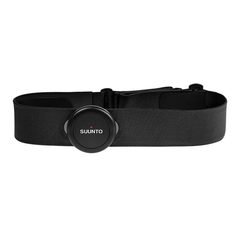
Suunto Smart Heart Rate Belt
The previous Suunto strap: Bluetooth with one active connection at a time, memory for roughly three and a half hours of data (built for swimming, where the phone is out of reach), a CR2025 coin cell rated at about 500 hours [Suunto; gadgetsandwearables 2026]. Bluetooth only, so check that your HRV app lists it; the common ones do.
Pick it if you find it discounted now that the Belt 2 is out. Suunto Smart Heart Rate Belt on Amazon
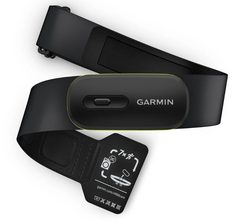
Garmin HRM 600
Garmin's premium strap, and the odd one out on batteries: a rechargeable cell on a proprietary clip, rated at about two months at an hour a day, rather than a coin cell that lasts a year. ANT+ plus three Bluetooth connections, heart rate and HRV sent live, about 24 hours of on-board storage, 5 ATM water rating, a detachable washable module and a long list of running dynamics [Garmin; the5krunner 2025]. It sends the RR data the test needs; almost everything else it does is for running with a Garmin watch.
Pick it if you already run with Garmin and want one strap for both jobs; for the test alone, it is more strap than you need. Garmin HRM 600 on Amazon
Which one is best
There is no single best strap for everyone, so here is the honest split. For the test and nothing else: the Polar H9. For the test plus training, or if you want the strap with a published RR-quality figure: the Polar H10. The Suunto and Garmin straps make sense when you already own the matching watch. All five need the strap wetted at the electrodes and worn snug just below the chest muscles, and all five will show a rough first minute while the electrodes settle, which is why the test's two minutes per rate start after a short lead-in.
Sources and disclosure
- Gilgen-Ammann R, Schweizer T, Wyss T. RR interval signal quality of a heart rate monitor and an ECG Holter at rest and during exercise. European Journal of Applied Physiology. 2019;119(7):1525-1532. PubMed 31004219
- Polar H10 and H9 specifications, polar.com, read September 2026. Suunto Smart Heart Rate Belt and Belt 2 specifications, suunto.com and press coverage (the5krunner, gadgetsandwearables), September 2026. Garmin HRM 600 specifications, garmin.com and reviews (the5krunner, Wareable), read September 2026. Specifications change; check the maker's page before buying.
Breathing Frequency takes part in the Amazon Associates program. Links marked as sponsored earn a commission on purchases at no extra cost to you. Product photography is the manufacturer's, credited under each image, and is used to identify the product; no maker paid for placement or supplied a unit. Nothing on this page is medical advice; a chest strap is a fitness sensor, not a medical device.